Man, I need to run the mean density of that sucker. Platinum has a density of 21.6 g/cc, one of the densest elements. Of course, it makes a bitchin' catalyst as well.
I'm having a little trouble with the whole premise (except for the orbital elements).
Dr Patrick Taylor, a scientist in the Planetary Radar department and lead of the observations said: “Its size, shape, and rotation suggest there is something more than gravity holding this object together or else the asteroid would break up due to its fast spin”
Held together by chemical bonds, i.e. it's one solid chunk of something rather than many small pebbles/etc. gravitationally attracted to each other.
However that just describes almost every minor planet we know of (the gravity thing is a qualification to move from "minor" to "dwarf" and beyond). To this layman it sounds like he just said "Water is wet (but this bit is kinda swirly)."
*6 hours later* Boy, either that is one difficult maths problem, or glasspusher has worked it out and is currently trying to bid on a bucket and spade and a rocket on ebay!
yeah, assuming a sphere (worst case for lowest density:Asteroid is ~ 90 millon metric tons, or 9 e10 kgDiameter is ~460 metersSo, volume, assuming a sphere (worst case) is 4/3 pi r^3, or 3.8e7 m^39e 10 kg / 3.8e7 m^3 = 2.35 e 3 kg/m3, or a specific gravity of 2.35, so big deal. Less than half the mean density of earth.If the asteroid is a potato or a lump, let’s say we’re high on the volume estimate by a factor of 3 or 4, that bumps it up to 7.5 to 9.5 ish g/cc. If that was the case, yeah, just iron or nickel isn’t going to explain away the density.I didn’t look up the albedo of the asteroid or shape, or how they determined the size.I didn’t run the problem until this morning 😉
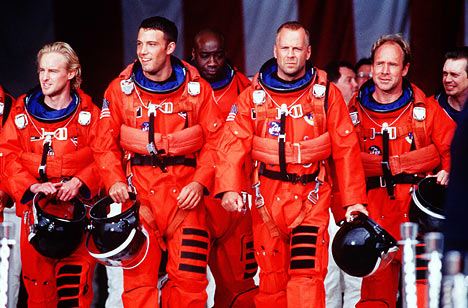

Sorry, I can't do photoshop, so you'll have to use your imagination and insert Sarah Hepawotsit's head yourselves.
Man, I need to run the mean density of that sucker. Platinum has a density of 21.6 g/cc, one of the densest elements. Of course, it makes a bitchin' catalyst as well.
I'm having a little trouble with the whole premise (except for the orbital elements).
Dr Patrick Taylor, a scientist in the Planetary Radar department and lead of the observations said: “Its size, shape, and rotation suggest there is something more than gravity holding this object together or else the asteroid would break up due to its fast spin”
Rubberbands? Elmers's Glue?
Oy.
Held together by chemical bonds, i.e. it's one solid chunk of something rather than many small pebbles/etc. gravitationally attracted to each other.
However that just describes almost every minor planet we know of (the gravity thing is a qualification to move from "minor" to "dwarf" and beyond). To this layman it sounds like he just said "Water is wet (but this bit is kinda swirly)."
Word count is word count.
I think the scientist's claim was:
"clingin' to your stocks and bonds, paying your HP demands forever"
*6 hours later* Boy, either that is one difficult maths problem, or glasspusher has worked it out and is currently trying to bid on a bucket and spade and a rocket on ebay!
yeah, assuming a sphere (worst case for lowest density:Asteroid is ~ 90 millon metric tons, or 9 e10 kgDiameter is ~460 metersSo, volume, assuming a sphere (worst case) is 4/3 pi r^3, or 3.8e7 m^39e 10 kg / 3.8e7 m^3 = 2.35 e 3 kg/m3, or a specific gravity of 2.35, so big deal. Less than half the mean density of earth.If the asteroid is a potato or a lump, let’s say we’re high on the volume estimate by a factor of 3 or 4, that bumps it up to 7.5 to 9.5 ish g/cc. If that was the case, yeah, just iron or nickel isn’t going to explain away the density.I didn’t look up the albedo of the asteroid or shape, or how they determined the size.I didn’t run the problem until this morning 😉