5 thoughts on “Whereas Obama’s material support for a disastrous Saudi-led war had drawn little protest in Washington, his words of muted criticism for Saudi Arabia provoked days of sustained outrage. His comments were denounced as “play[ing] the blame game”; “betraying a grievous misunderstanding of what it means to be the world’s No. 1”; “the mark of a careless and clumsy amateur”; “turn[ing] allies overboard”; “overweening arrogance”; blaming others for his own failures; comparable to Donald Trump; and so on.”
Spending on think tanks was effective, especially compared with other methods of buying influence.
Lobbying firms are for-profit businesses designed to extract the highest possible payment from their clients. Think tanks and academic institutions have lots of influence but less of a profit-maximizing mindset. They didn't see themselves or their influence as for sale, but the foreign donors clearly believed they were getting something in the bargain…
This came as the financial crisis, which had begun a few years earlier, was being felt at think tanks as well as universities, where budgets had tightened dramatically. Grants from the US government or from domestic donors were drying up as well. The institutions were in desperate need of money just as the Gulf checkbooks arrived…
It wasn't enough that W destroyed our economy and our foreign policy in the Middle East during his presidency, eh?
The New York Times, that year, published an investigation on foreign government funding at think tanks, which the paper found had risen dramatically. It identified millions in donations going to many of Washington's most influential institutions, which were "producing policy papers, hosting forums and organizing private briefings for senior United States government officials that typically align with the foreign governments’ agendas."
The Times investigation detailed several incidents in which donations from foreign governments had seemed to directly influence think tank behavior:
Saleem Ali, a former visiting scholar at the Brookings center in Qatar, said he had been told not to write critically of the Qatari government.
Emails between the Center for Global Development and the Norwegian government seemed to indicate a quid pro quo in which Norway would "donate" to CGD, which in turn would help persuade US government officials to increase funding for global forest protection efforts by $250 million.
The Japanese government gave to CSIS, which now sponsors Japanese officials as "visiting scholars" who are granted access to US government officials by way of CSIS events and preexisting relationships.
The United Arab Emirates, also a CSIS donor, got its ambassador to the US invited to participate on a public panel alongside then-Chairman of the Joint Chiefs Martin Dempsey, whom the ambassador grilled about US commitments to the UAE.
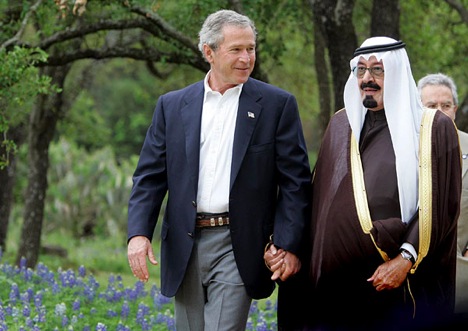

tl;didn't riyadh
You Saudi light.
Well, nobody's perfect.
It wasn't enough that W destroyed our economy and our foreign policy in the Middle East during his presidency, eh?
tl;dr:
<img src="https://media.giphy.com/media/10A2qk8IALiPug/giphy.gif">
Saudi Arabia is why nobody in this country has a leg to stand on to bitch about Cuba.